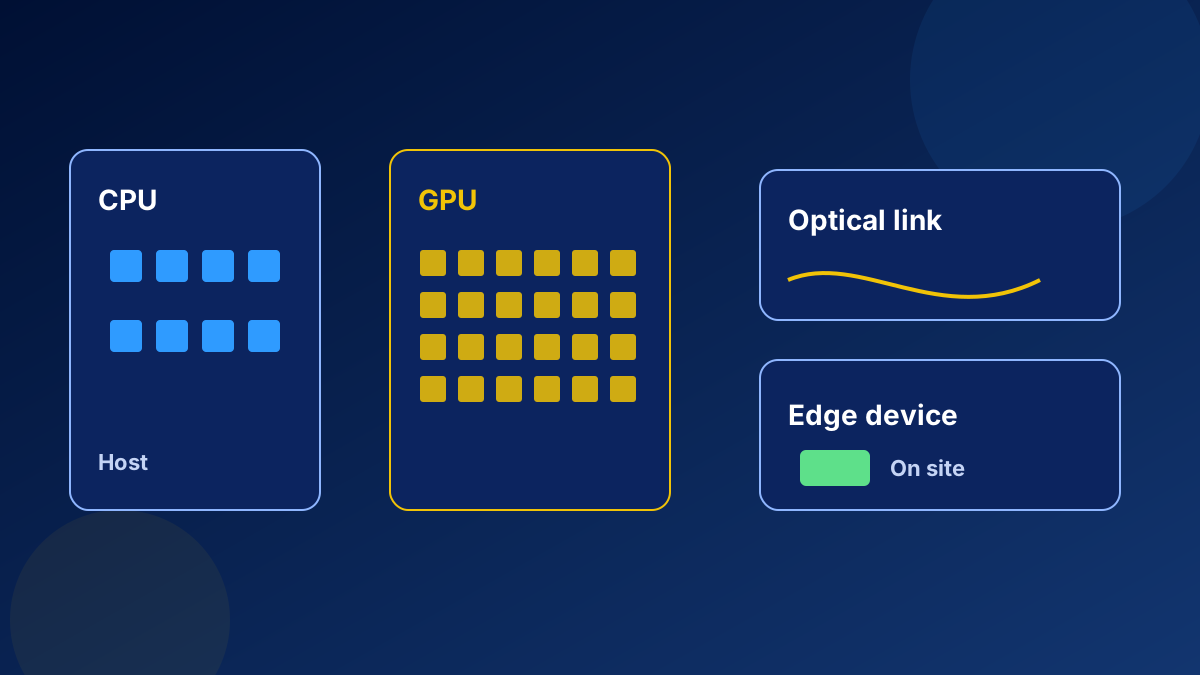
Enterprise technology is not moving toward a single replacement for the CPU. The nearer change is heterogeneous computing: general-purpose processors, GPUs and other accelerators, cloud services, edge devices, and software that decides which of those resources a workload should use. This article separates seven frontiers that are often bundled together in marketing. Some are production practice today. Others are research programs with narrow demonstrations. Treating them as one roadmap produces bad architecture.
The descriptions below follow primary documentation from NVIDIA, Kubernetes, the Model Context Protocol, NIST, IBM, and Intel. Forecasts and research-stage claims are labeled as such. Nothing here is a claim that MQGen has deployed every technology, or that any one vendor stack is mandatory.
Frontier 1: AI-native and accelerated computing
A CPU and a GPU are built for different kinds of work. NVIDIA’s CUDA programming model assumes a heterogeneous system: applications start on the CPU, the host, and launch kernels on a GPU, the device. Host code copies data, starts device code, and waits for it. The CPU and GPU can run at the same time, and CUDA’s own guidance is to use both rather than to treat the GPU as a substitute for the CPU. On the device, threads are grouped into warps of 32 that follow a single-instruction, multiple-thread execution model. That organization is a good fit for highly parallel numeric work. It is a poor fit for sparse, branch-heavy control logic, where warp divergence leaves lanes idle. NVIDIA CUDA programming model
Training large models and serving some inference workloads are the usual reasons to buy GPU capacity. They are not the only numeric workloads that benefit, and they are not a reason to put every service on a GPU. A request that is mostly business rules, a small model that already meets its latency target on CPU, or a call to an external model API may never touch a local accelerator. Specialized accelerators beyond GPUs, including other vendors’ data-center GPUs and dedicated inference processors, exist for the same reason: some kernels are dominated by parallel matrix math. The engineering question is whether the model, the software stack, and the utilization justify the device.
Distributed training and large inference deployments also move a great deal of data between devices. Bandwidth, distance, and the power used to move that data become first-order design constraints, not a networking afterthought. Accelerator racks concentrate power and heat. Idle or poorly scheduled devices still occupy capital, power, and cooling even when they are not producing useful work. Utilization, queueing, and placement matter as much as the peak specification of the chip.
Kubernetes can place GPU workloads, but only after the node is prepared. Kubernetes documents stable support for managing AMD and NVIDIA GPUs through device plugins. An administrator installs the vendor driver and the vendor plugin. The cluster then advertises an extended resource such as nvidia.com/gpu or amd.com/gpu. Pods request that resource in limits. Kubernetes schedules the pod onto a node that can satisfy the request. It does not decide that a workload is an AI workload, and it does not make every pod GPU-accelerated. Schedule GPUs Device plugins
The NVIDIA GPU Operator automates the software around that path inside Kubernetes: drivers, the container toolkit, the device plugin, node labeling, and DCGM-based monitoring. That is node preparation. It is not model training, agent orchestration, or a protocol for tools. NVIDIA GPU Operator
Use GPU infrastructure when the workload is parallel enough to occupy the device, the software stack supports it, and the latency, throughput, or training-time target is not met by CPU capacity or by a managed model endpoint at an acceptable cost. Keep CPU capacity for control planes, data services, and everything that does not map cleanly onto the accelerator.
Frontier 2: Agentic computing
A language model produces outputs from its parameters, the current input, and the context it is given. It does not, by itself, hold credentials for enterprise systems. An AI agent is an application pattern around a model: instructions, a goal, and a set of tools the application is willing to let the model request. A deterministic workflow is different again. Its steps are defined by the program, not chosen at runtime by a model. Many production systems need all three: a workflow for the path that must be repeatable, a model for language or classification, and an agent only where the next step genuinely depends on intermediate results.
The Model Context Protocol is one way to expose tools, resources, and prompts to a compatible application. MCP’s own architecture describes a host that creates a client for each server. Servers provide context. The protocol does not dictate how the application uses a language model, and connecting a server does not grant the model access to every system behind it. Remote transports are expected to use ordinary HTTP authentication, with OAuth recommended. Tools are executable functions the application may invoke, such as a query or an API call. Resources are data. Prompts are templates. Each of those is discovered and called explicitly. MCP architecture
Multi-agent designs split work across several model-backed roles. That can isolate tools and instructions. It also adds failure modes: agents can disagree, loop, or take actions on stale context. Autonomous execution is not a reliability property. NIST’s AI Risk Management Framework, released as version 1.0 on January 26, 2023, is a voluntary framework for incorporating trustworthiness into the design, development, use, and evaluation of AI systems. It does not make an agent safe by citation. It is a reminder that risk management, evaluation, and operational controls are part of the system. A later generative-AI profile, NIST AI 600-1, was released on July 26, 2024. NIST AI RMF
Useful enterprise applications are narrow. Incident triage can gather logs, propose a severity, and open a ticket, while a person approves a production change. Knowledge retrieval can answer from documents the caller is already allowed to read. Operational automation can run a defined tool with a timeout, an audit record, and a permission check. None of those applications should be built as an unbounded controller of infrastructure.
Frontier 3: Quantum computing
Classical machines store and process bits. Quantum processors use qubits. IBM’s introduction describes a qubit as able to hold a weighted combination of zero and one, called superposition, until measurement returns a definite result. Groups of qubits can be entangled, so a measurement on one is correlated with others. Quantum algorithms use interference to amplify some outcomes and cancel others. Decoherence, the loss of the quantum state through measurement or the environment, is a central engineering limit. IBM is explicit that the field is still in development, and that the practical interest is in particular classes of problems, especially modeling physical systems such as chemistry and materials, not in replacing ordinary enterprise software. IBM: What is quantum computing?
That distinction matters. A demonstrated research result, or access to a cloud-hosted quantum processor for experimentation, is not the same thing as a general-purpose computer that should be on an application architecture diagram next to a CPU or GPU. Quantum processors are not drop-in accelerators for web requests, data warehouses, or model inference. Claims about a future industry size are forecasts, not operating plans, and this article does not rely on them.
The enterprise issue that is already concrete is cryptographic migration. NIST’s post-quantum cryptography project states that quantum machines able to break many of today’s public-key systems may be years or decades away, and that organizations should begin migrating now. NIST released three initial standards in August 2024, FIPS 203, FIPS 204, and FIPS 205, and has said quantum-vulnerable algorithms will be removed from its standards by 2035, with earlier transitions for high-risk systems. Inventorying where vulnerable algorithms are used is a present program of work. Buying a quantum computer is not. NIST post-quantum cryptography
Frontier 4: Edge and physical AI
Some inference has to run near the camera, the robot, the vehicle, or the plant network. The reasons are ordinary systems constraints. A round trip to a central region may miss a control deadline. A site may not have the bandwidth to upload every frame. Connectivity may be intermittent. Raw video or operational telemetry may be too sensitive to leave the site. Power on the device is finite, so the model that runs there is often smaller, quantized, or specialized.
Edge inference does not replace a central platform. Training, evaluation datasets, model registries, identity, and fleet-wide policy are usually easier to run where the organization already operates its cloud or data center. A durable pattern is split responsibility: the device or local cluster handles the latency-sensitive inference, and the central platform handles governance, updates, and workloads that need more data or more compute. Physical systems such as robotics, industrial automation, computer vision, and connected equipment add safety constraints that a chatbot does not. A wrong action can move a machine. Those workloads need the same permission, timeout, and audit thinking as any other automation, plus the physical limit of the equipment.
Kubernetes and GPUs still apply only where they fit. A small device may run a container runtime without a cluster. A factory cell may have one GPU. A central training job may use a scheduled GPU pool as described in Frontier 1. The architecture should show that choice, not a single pipeline that forces every sensor reading through a cluster and a GPU.
Frontier 5: Neuromorphic computing
Neuromorphic hardware takes cues from biological nervous systems, especially event-driven or spiking computation, where work is triggered by changes rather than by a constant clocked stream of dense matrix multiplies. The appeal is energy use on sparse, specialized workloads. Intel Labs describes Loihi 2 and the larger Hala Point system as neuromorphic research, and says research on Loihi 2 has shown large efficiency gains on small-scale edge workloads. Intel also describes the work as progressing from research prototypes toward products over the coming years. Intel neuromorphic computing
Those statements are vendor research claims about research systems. They are not evidence that neuromorphic processors are a general enterprise platform, a replacement for GPUs, or a default choice for business applications. Most enterprise models, frameworks, and operators are built for CPUs, GPUs, and conventional accelerators. Adopting a neuromorphic device means a different programming model and a narrow set of suitable workloads. Broad commercial adoption should not be written into a current-year architecture.
Frontier 6: Photonic computing and optical interconnects
Light is already used to move data. Intel’s silicon photonics products are connectivity devices: photonic integrated circuits and lasers embedded in optical transceivers, and optical I/O aimed at high-bandwidth links for compute platforms, including links co-packaged with CPUs, GPUs, and other processors. The documented purpose is bandwidth, reach, and the energy cost of communication, not a claim that the optical device executes application logic. Intel silicon photonics
Optical communication and optical computing are different ideas. An optical interconnect still connects electronic processors. Optical computing, in the research sense, tries to perform computation in photonic devices. Shipping transceivers do not make photonics a universal replacement for electronic CPUs or GPUs. In AI data centers the practical question is usually signal integrity and power over distance: electrical links struggle as bandwidth and cable length grow, and optical links are one response. The processors at each end remain electronic unless a specific optical-compute research system is part of the design, which should be treated as research.
Frontier 7: Confidential and distributed computing
Distributed computing places work across more than one computer: regions, availability zones, edge sites, and specialized pools such as GPU nodes. The engineering problems are placement, identity, network boundaries, retries, timeouts, consistency, and what happens when a site is unavailable. Kubernetes is one control system for the containerized part of that problem. It schedules pods, restarts failed containers, and can scale a deployment. Kubernetes’ own overview is careful about the limit: it does not deploy source code, it does not include databases or message buses as built-in services, and it does not dictate the logging stack. It also describes itself as a set of control loops toward a desired state, not as a workflow engine that must run step A, then B, then C. Kubernetes overview
Confidential computing is a different control. NIST IR 8320 describes protecting data in use, alongside encryption at rest and in transit, by processing data inside a hardware-backed trusted execution environment. A TEE is a processor-protected area. Secrets can be used inside it without being exposed to the surrounding operating system, and remote attestation lets a relying party check that it is talking to a genuine environment running expected code. The report points readers to the Confidential Computing Consortium for the industry term. A TEE does not make a workload distributed, and distributing a workload across regions does not make it confidential. An architecture can use either, both, or neither. NIST IR 8320
Governance sits across both ideas. Identity decides who or what may call a service. Policy decides which data and which tools are in scope. Audit records the call. Multi-region resilience decides where a workload may run and how it fails. None of those controls are implied by the word “distributed” or the word “confidential.”
What to adopt, and when
The practical direction for the next few planning cycles is heterogeneous computing. CPUs remain the default. GPUs and other accelerators are added for workloads that can use them. Cloud services, edge devices, and conventional software share the work. Agents are introduced as applications with tools and limits, not as a new infrastructure layer that replaces orchestration. Quantum, neuromorphic, and optical computing stay on a watch list unless a specific research or industry workload requires them. Optical interconnects and post-quantum cryptography are easier to justify in current programs because they address production constraints: moving data, and protecting it against a future cryptographic break.
A realistic sequence for an enterprise program:
- Establish secure, observable cloud and data foundations: identity, encryption, logging, metrics, traces, and data ownership.
- Identify workloads that benefit from AI acceleration, and keep the rest on CPU or on an external model service.
- Build governed inference and, where needed, agent workflows with explicit tool permissions and evaluation.
- Introduce automated operations with bounded permissions, timeouts, and human approval for sensitive actions.
- Evaluate emerging hardware against a business requirement and against its actual maturity, not against a category name.
Comparison
| Frontier | Current maturity | Practical applications | Primary engineering considerations |
|---|---|---|---|
| AI-native and accelerated computing | Production for supported workloads. GPUs are scheduled in Kubernetes only when drivers, a device plugin, and resource limits are configured. | Model training, compatible inference, and other parallel numeric jobs. Not every AI call needs a local GPU. | CPU versus GPU fit, utilization, power and cooling, interconnect bandwidth, and workload placement. |
| Agentic computing | Production only with application controls. A model plus tools is not automatically reliable. | Incident triage, knowledge retrieval, and operational automation inside explicit permissions. | Separate the model, the agent, and the deterministic workflow. Require authentication, least privilege, evaluation, audit, and approval for sensitive actions. |
| Quantum computing | Research and early cloud-accessible hardware. Not a general-purpose replacement for CPUs or GPUs. | Scientific simulation, chemistry, and materials research. Post-quantum cryptography migration is the enterprise action available now. | Do not conflate demonstrations with production systems. Plan cryptographic inventory separately from quantum hardware. |
| Edge and physical AI | Production for specific devices and sites. Central training and governance usually remain elsewhere. | On-device inference, computer vision, robotics, and industrial automation. | Latency, bandwidth, connectivity, privacy, power, and safe interaction with physical equipment. |
| Neuromorphic computing | Research systems such as Intel Loihi 2 and Hala Point. Not broad enterprise infrastructure. | Experimental sparse, event-driven, and small-scale edge workloads described by the research programs. | Different programming model. Do not treat vendor research results as a general efficiency guarantee. |
| Photonic computing and optical interconnects | Optical interconnects and transceivers are production networking. General-purpose optical computing is not a processor replacement. | High-bandwidth links inside and between AI and data-center systems. | Separate moving data with light from computing with light. Design for bandwidth, distance, power, and signal integrity. |
| Confidential and distributed computing | Both are established ideas. Distribution is routine. Hardware TEEs are available on some platforms and are a specific control, not a synonym for multi-region design. | Multi-site resilience, workload placement, and protecting data while it is processed. | Identity, policy, attestation, key release, and failure behavior. Encryption in use does not replace encryption at rest and in transit. |
Related reading
- Kubernetes operators, and how GPU scheduling actually works
- Using AI assistance in delivery pipelines without giving up control
- Quantum computing as a planning problem, not a platform replacement
- Zero trust for the systems agents and models will call
Sources
- NVIDIA, CUDA Programming Guide, programming model
- Kubernetes, Schedule GPUs
- Kubernetes, Device plugins
- NVIDIA, GPU Operator
- Kubernetes, Overview
- Model Context Protocol, Architecture overview
- NIST, AI Risk Management Framework
- IBM, What is quantum computing? Published 10 June 2025, updated 2 April 2026
- NIST, Post-quantum cryptography
- Intel Labs, Neuromorphic computing
- Intel, Silicon photonics
- NIST IR 8320, Hardware-Enabled Security: Enabling a Layered Approach to Platform Security for Cloud and Edge Computing Use Cases
- OpenTelemetry, What is OpenTelemetry?
OpenTelemetry is the reference used here for metrics, logs, and traces as portable telemetry. It is a framework for generating and exporting that data. It is not itself an observability backend. Evaluation of model and agent behavior is an application concern and is not provided automatically by the telemetry pipeline.