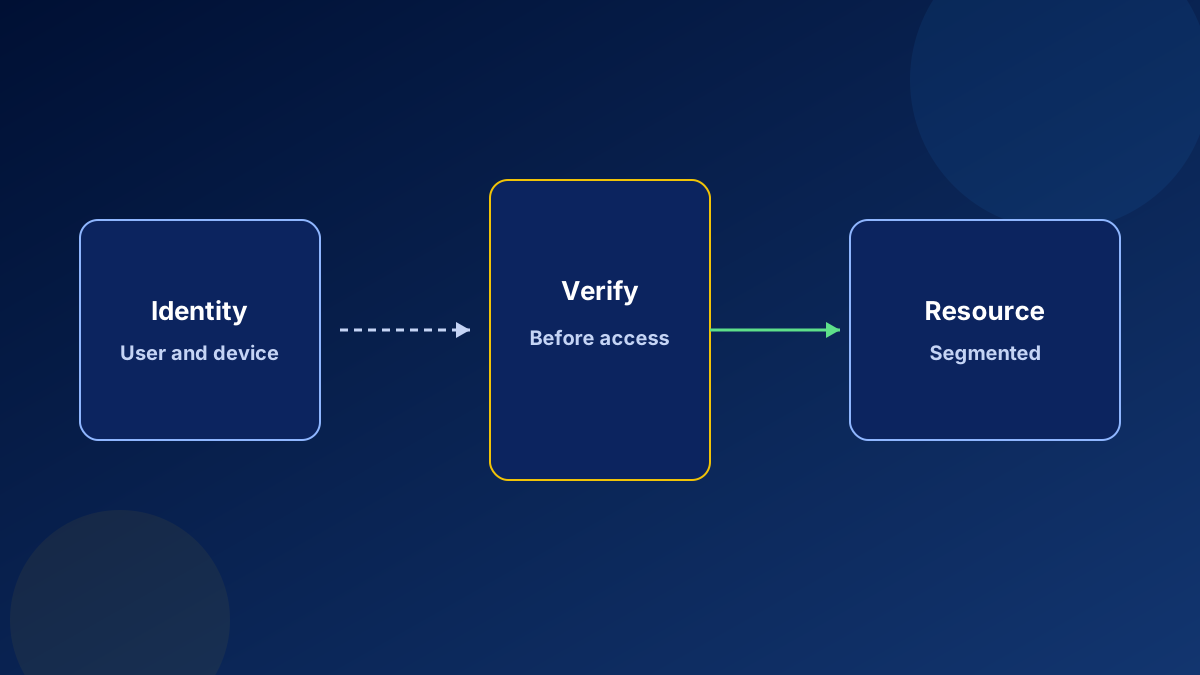
“From scratch” is the wrong scale if it suggests a weekend replacement of the corporate network. NIST Special Publication 800-207, published in August 2020, defines zero trust as a shift from static, network-based perimeters toward users, assets, and resources. A zero trust architecture assumes no implicit trust for an asset or account solely because of its physical or network location, or because the enterprise owns the device. Authentication and authorization happen before a session to an enterprise resource is established. NIST SP 800-207
That definition is useful because it is narrower than product marketing. Zero trust is not a firewall brand, a VPN replacement slogan, or a guarantee that a network is safe. It is a planning assumption: network location is no longer treated as the main security decision. The paper was written against trends that include remote users, personal devices, and cloud assets that do not sit inside an enterprise-owned boundary.
What a program actually has to decide
Start with the resources, not with a diagram of zones. Which applications, data sets, and administrative interfaces matter, and who or what is allowed to reach them? NIST’s framing separates the subject and the device. A valid user on an unmanaged laptop is not the same decision as a valid user on a managed one. Policy has to say so.
Identity is the control most programs underbuild. Service accounts, pipeline identities, and workload identities need the same explicit authorization as people. A model or an agent that can call an API is another subject. It should receive only the scopes required for that action, and the grant should be revocable. See the computing frontiers article for how tool access differs from model inference.
Observe the decision. Zero trust that cannot explain why a request was allowed or denied is difficult to operate. Logs of authentication, device posture, and authorization are part of the design, not a later integration. Encryption in transit protects the session. It does not decide whether the session should exist.
A practical sequence
- Inventory the resources that hold sensitive data or can change production.
- Remove assumptions that “on the network” means trusted. Require authentication at the resource.
- Differentiate user, device, and workload identity in policy.
- Give automation, including AI tools, least-privilege credentials and an audit trail.
- Measure denied and allowed access so the policy can be corrected. A policy nobody can explain will be bypassed.
This is an operating model. It does not require a single vendor, and it does not obsolete segmentation, patching, or backup. Those controls still reduce blast radius when a credential is stolen.
Related reading
- Next-generation computing: confidential computing is not the same control
- AI assistance in delivery pipelines
- What a blockchain does and does not replace