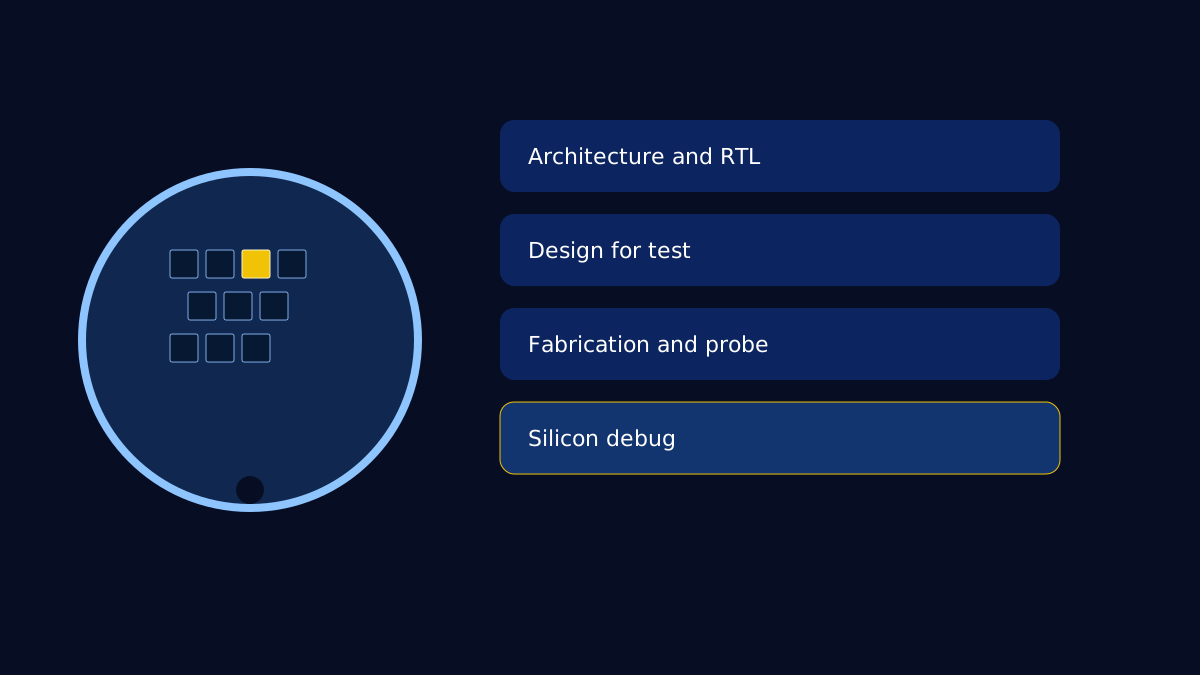
A semiconductor program is easier to staff, and easier to misunderstand, when it is treated as one job with many titles. It is a sequence. Architecture decides what the chip is. Register-transfer level (RTL) code describes the digital behavior. Design for test makes a finished part measurable. Verification tries to show the description matches the specification before wafers exist. Fabrication builds the devices. Probe and production test screen them. Post-silicon validation is what happens when the part in the lab does not match the model.
MQGen’s services page uses the same map when a company describes a role. This note is the longer version of that map. It is not a claim that one person covers every stage, and it is not a market forecast.
Architecture and RTL
System-on-chip and application-specific work starts with a boundary: which blocks exist, how they share time and power, and what “done” means for each interface. Digital design writes that behavior as RTL. The useful review of a designer is not the acronym on a résumé. It is which block they owned, which language and simulator the team used, and whether the code survived a specification change.
Design for test
Design for test adds structure so a chip can be tested at speed and at volume. Scan insertion turns flip-flops into shift registers. Automatic test pattern generation builds patterns for a fault model. Memory built-in self-test exercises on-chip memories. Coverage is the share of faults those tests can see. A DFT engineer who has inserted memory test on a real subsystem is a different match from someone who has only studied scan theory.
Verification, then silicon
Functional verification uses simulation, formal checks, and sometimes a hardware-assisted run to compare behavior with the specification while a change is still a code change. Pre-silicon validation happens before wafers exist. After fabrication, wafer probe tests each die, and production test screens packaged parts. Yield work ties a failure back to the process, the design, or the test program. Post-silicon debug is the slow part: timing, power, and analog behavior that the model did not show.
Where the same loop shows up
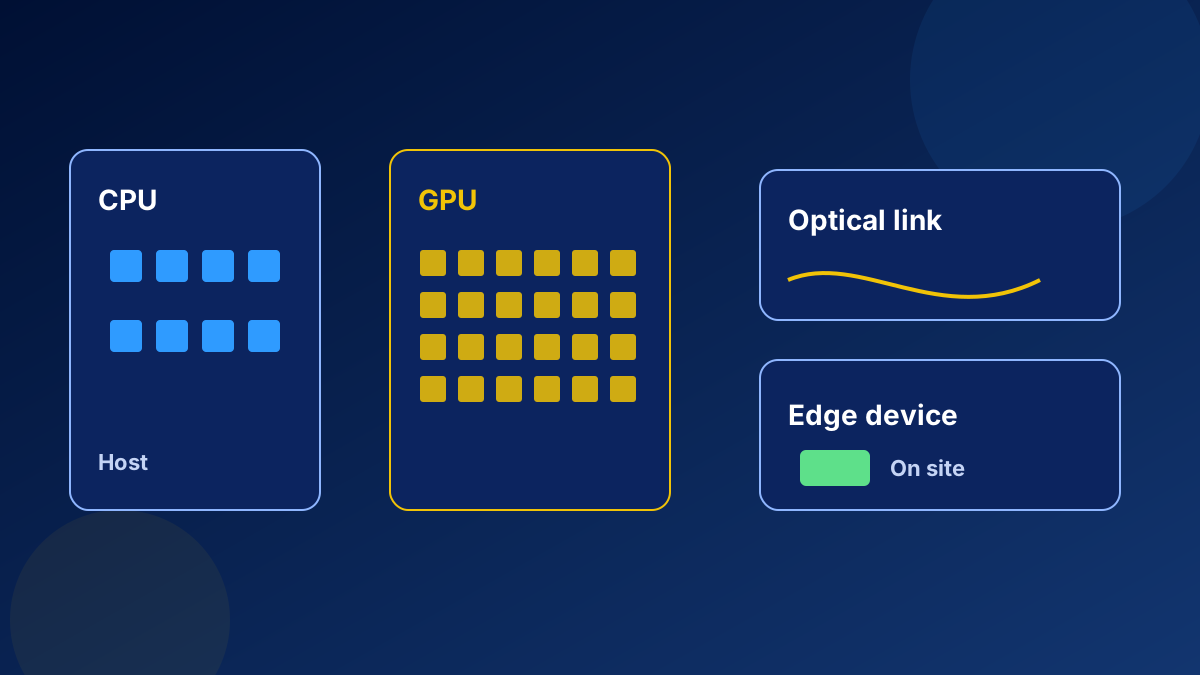
An accelerator for a training cluster, a power device in a vehicle, and a controller in a factory sensor go through the same loop. What changes is the constraint. Throughput and memory bandwidth dominate one program. Functional safety and temperature dominate another. The job title often stays the same while the bench, the tools, and the definition of done do not.
World Semiconductor Trade Statistics reported global sales of $795.6 billion for 2025, released 6 March 2026. That is an industry shipment total, not a measure of any one company’s hiring. WSTS full-year 2025 results