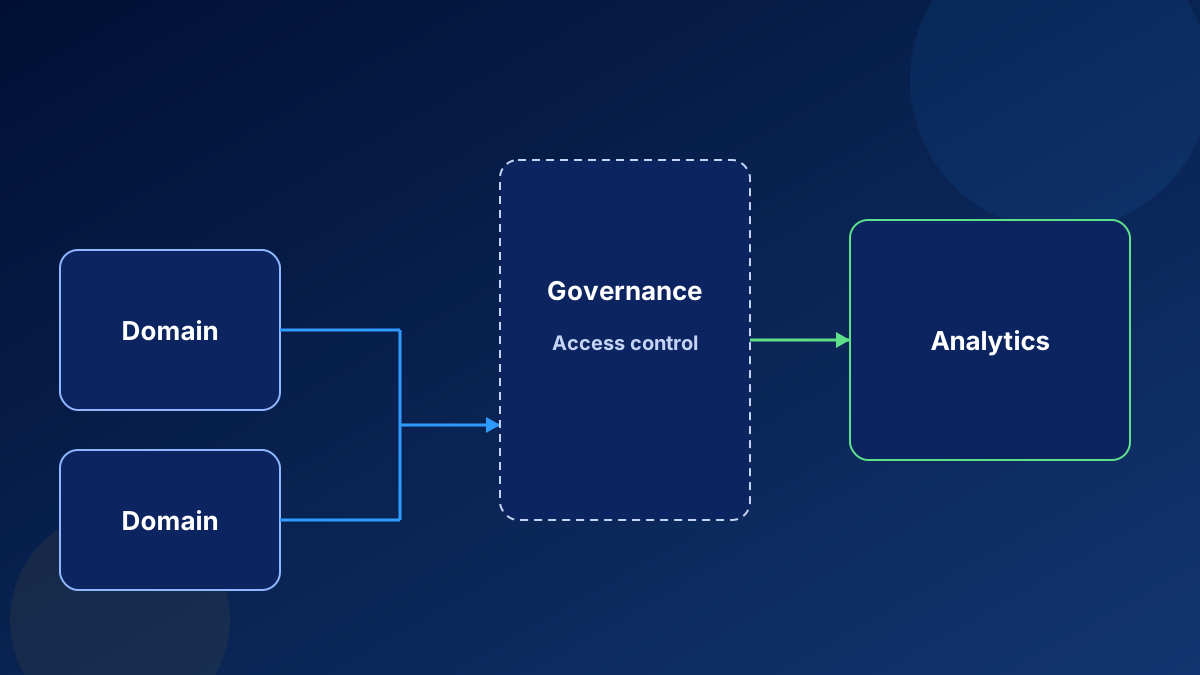
Data mesh and data fabric are both responses to the same pain: analytical data that is slow to change, owned by a central team that cannot know every domain, and reached through a thicket of pipelines. They are not competing products, and they are not synonyms.
Data mesh, as specified
Zhamak Dehghani’s 3 December 2020 article on Martin Fowler’s site states four principles: domain-oriented decentralized data ownership and architecture, data as a product, self-serve data infrastructure as a platform, and federated computational governance. The article distinguishes operational data, which serves the current state of a business capability, from analytical data, which is a historical view used for reporting and for training models. Data mesh is aimed at the analytical side, and it argues that the people closest to a domain should own the analytical data products for that domain, using shared platform capabilities and computational policies rather than a single central integration team. Data Mesh Principles and Logical Architecture
The article is explicit that it is not a tool recipe. Implementing it means domain teams can publish data products, consumers can find and access them under policy, and the platform team provides the paved path. It does not mean every microservice database is opened to analysts, and it does not remove the need for quality, schema, and access control.
Data fabric
Data fabric is an industry term for connecting distributed data with shared metadata, governance, and access paths so consumers are not hand-building every integration. There is no single ISO standard under that name that this article can point to, so it should not be drawn as a box that is equivalent to Kubernetes or to a particular vendor catalog. A fabric-style program can be centralized. A mesh-style program is deliberately distributed in ownership. A company can use shared metadata tooling, which people may call a fabric, inside a mesh operating model. Buying the tooling does not create domain ownership.
What this means for AI workloads
Models and agents need data they are allowed to use, with a known source and a way to evaluate quality. Retrieval over documents is one pattern. It is not required for every model call. A warehouse, an operational API, or an event stream may be the right source. The governance question is the same in each case: who owns the data, who may read it, and how a bad record is corrected. Those are data-platform decisions. They are not solved by placing a vector database on the diagram by default. The layered picture is in Next-Generation Computing.